

22 September
Unreal Things
You are being taken hostage and left alone on an island forever. The people who leave you there give you two options.
a) You get a phone call for five minutes every day with one person of your choice, forever, and that’s it.
b) You get to see and meet one person only once a year. You can touch, hug, and talk to them face-to-face, but only once a year. Which one would you choose and why?
If you could change one thing in your past, what would it be?
If you could switch souls with one person on this earth for one day, who would it be and why them?
If you could live in any fictional world, which one would it be and why?
If you were invisible for a day, what would you do?
If you could time-travel, would you rather go to the past or the future? Why?
If you could live forever, would you want to? Why or why not?
If you could live anywhere in the world with no limits, where would it be and why?
If you could erase one invention from history, which one would it be and why?
Related Words: imagination, fantasy, hypothetical situations, alternate reality, time travel, parallel universe, invisibility, immortality, fictional world, supernatural, possibilities, dreams, illusions, creativity, speculation, what-if scenarios, unreal experiences, mind experiments, alternate choices, decision-making, consequences, surreal, extraordinary, beyond reality, escapism, magical thinking, hypothetical choices, future possibilities, past changes, imaginative thinking
Watch the video above and discuss what you learned from it during your Spoken Cafe session

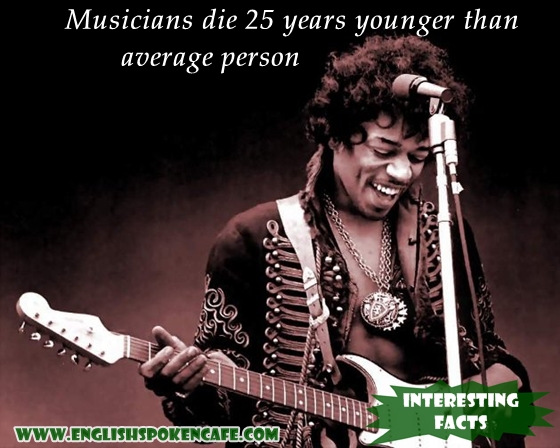
Study Shows Musicians Have Shorter Lifespans: 25 Years Less Than the Average
A study conducted by a professor from the University of Sydney titled “Stairway to Hell: Life and Death in the Pop Music Industry” explored the lives and deaths of musicians from 1950 to June 2014. This study looked at factors like lifespan, suicides, homicides, and accidental deaths. The goal was to understand whether musicians live shorter lives compared to the general population.
To conduct this research, the professor calculated the average age at which musicians died, separating the results by sex and the decade of death. These findings were then compared to the average lifespans of the general U.S. population during the same periods.
The results were surprising: musicians, on average, lived 25 years less than people in the general population. The study suggests that the pressures and lifestyle choices that often come with being in the music industry may contribute to these shortened lifespans.
Watch the video above and discuss what you learned from it during your Spoken Cafe session
READ/SPEAK
Do you know any celebrities who had a tragic end? Why do you think those people had such an end like that?
Do you believe the pressures of fame and success contribute to health problems? How?
How do you think the lifestyle of a musician differs from that of an average person?
Do you think other creative professionals, like actors or writers, face similar challenges? Why or why not?
If you had the chance to live the life of a famous musician for a year, would you do it? Why or why not?

“he went broke owing two million pounds”
LEARN THE IDIOM AND SPEAK
Do you have any financial problems these days, or do you sometimes get broke? What are the effects of inflation on your lifestyle? What do you think are the solutions for a better life and economy?