
20-21 June
Human Rights
What is a human right?
What isn’t a human right?
Why are human rights important for society?
Do you think any human rights are more important than others?
What are some examples of human rights violations?
What is the relationship between human rights and freedom?
How can social media influence the fight for human rights?
Are there any human rights that you think should be protected more strongly?
Related Words: human rights, civil rights, freedom, equality, justice, dignity, rights protection, legal rights, social justice, discrimination, inequality, human rights violations, advocacy, activism, freedom of speech, freedom of expression, right to education, right to healthcare, international law, humanitarian issues, protection, fairness, accountability, global rights, social awareness, policy, governance, civil liberties, human dignity, rights awareness
Watch the video above and discuss what you learned from it during your Spoken Cafe session

Are We Becoming Less Empathetic?
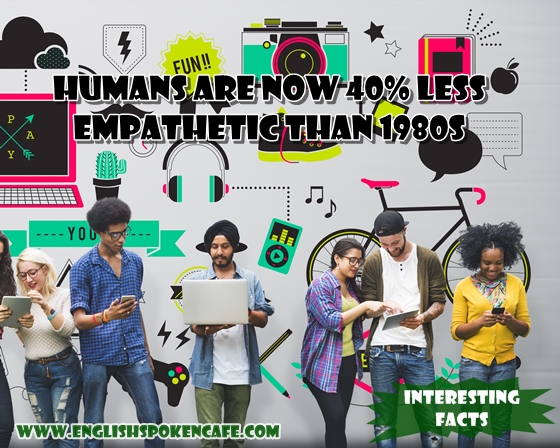
A study conducted by the University of Michigan in 2009 reveals a striking decline in empathy levels compared to previous decades. According to the research, people today care about others 40 per cent less than those in the 1980s.
Sarah Konrath, the study’s lead researcher, attributes this decline in empathy to an increasingly self-centred mindset among the younger generation. She describes today’s youth as being among “the most narcissistic, competitive, confident, and individualistic” in recent history.
However, this shift isn’t entirely the fault of the younger generation. Researchers point to societal changes as significant contributors. The rise of social media has reduced face-to-face interactions, which are vital for developing genuine empathy. Furthermore, the pressures of modern society, with its emphasis on competition and a “succeed-at-all-costs” mentality, have also played a role.
Edward O’Brien, another researcher involved in the study, explains that modern expectations prioritise personal achievement over emotional connections. For many young people, investing time and effort in understanding others is often seen as less valuable than working toward their own goals.
This study sheds light on how cultural and technological shifts are reshaping our capacity for empathy and emphasises the importance of finding balance between personal ambitions and meaningful connections with others.
Watch the video above and discuss what you learned from it during your Spoken Cafe session
READ/SPEAK
What are the reasons the new generation is becoming more self-centred? Do you think they are self-centred because they are evil, or are they more selfish because of the common situation in the world?
Do you believe social media has made people less empathetic? Why or why not?
Do you think competition in society makes people care less about others?
How do you think technology affects human relationships and empathy?
Do you think younger generations today are more or less kind than older generations? Why?

Stop and accept a small loss, rather than continue and risk losing everything.
LEARN THE IDIOM AND SPEAK
Tell us about the biggest risk you have taken in your life. What were the consequences? Are you planning to take any risks these days?